Here is where it all began
Marietta women were meeting as a club as early as 1896. They formed the Marietta Woman’s Club in 1909 and in 1920 organized to join the Georgia Federation of Women’s Clubs during a meeting at the Clarke Library, 156 Church Street. Sixteen women were present. The women desired “a wider scope in thought, a clearer conception of the arts and sciences and a more cultured community.” The meetings were to be held in the Marietta High School auditorium and the cost to join the club was a 50 cent initiation fee and a 50 cent annual dues.
At first the club existed largely for self culture. Literacy, arts and crafts, history and home economics were classes the women conducted and attended. It is a tribute to the founders that the Club so soon involved into a combination of study and service. Georgia certainly provided enough areas of service for those dedicated women with all the problems inherent in making the transition from an agriculturally oriented society to one that was more industrial.
In her book The First Hundred Years, Sara Blackwell-Gober-Temple mentioned that the growth of women’s organizations was a notable feature of the last years of Cobb County’s first century. She stated that “women had recently been given the ballot and understood the power they exercised through vote-less years as ample proof that all that remained was to come together in organizations and pool their efforts.”
Ms. Blackwell-Gober-Temple says that the “hearty interest of the first women’s clubs in Cobb County were the improvement of schools, encouragement of better citizenship, library extension, good roads and the beautification of highways.” Cobb clubs sponsored the growing Dixie and Bankhead Highways. When the cry of “Pull Georgia out of the mud!” was resounding through the state in the middle nineteenth twenties, no voices were more evident that were the Cobb women’s clubs. They also worked to develop the county fairs, the state flower shows and the improvement of rural schools and the lessening of adult illiteracy in Cobb County.
The first monthly meeting of the GFWC Marietta Woman’s Club was held on a Tuesday, February 24, 1920. The focus of the meeting was to “secure such local legislation as will keep children off the streets at night and a strong effort was also made to prevent the use of profane and improper language upon the part of the children of the town.”
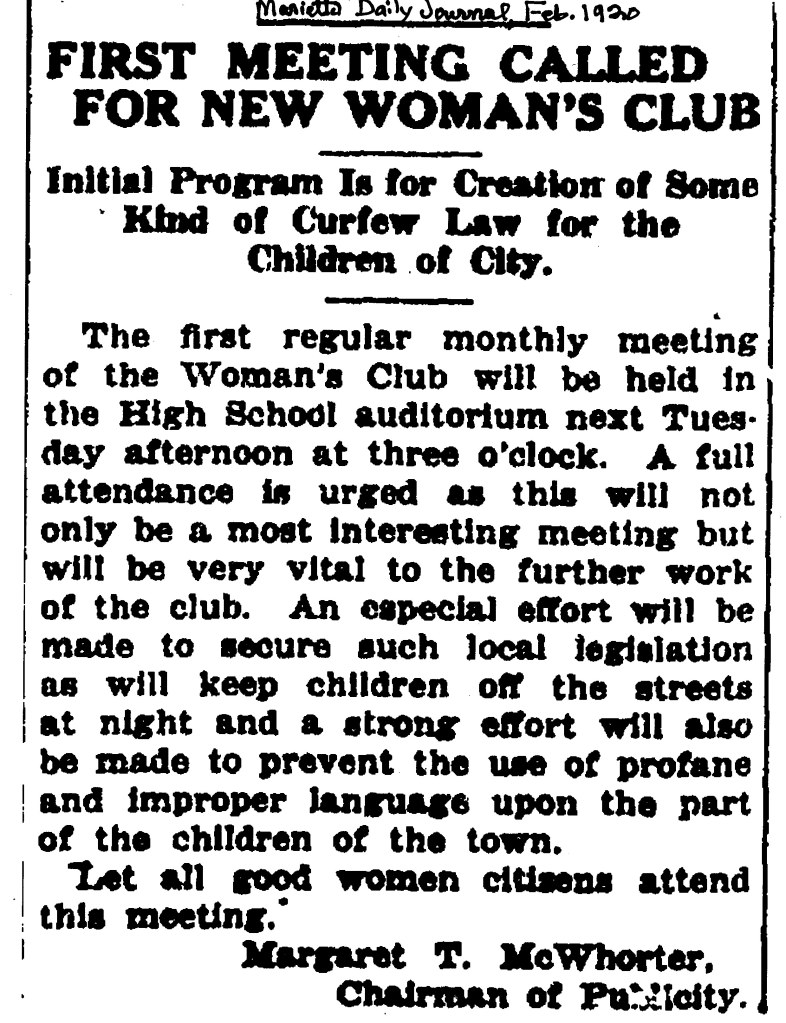
It was stated in a Cobb County Times newspaper article that “no organization has been made since the war period which so clearly brings forth the best which the womanhood of Marietta has to offer… which will centralize upon the one focal point of a more cultured home town.”
In July, 1922 the Parent-Teacher Association, which later became a separate organization, was added as a committee of the Woman’s Club.
Other notable early projects of the Club were:
- In September 1920 the club made their first contribution to the Tallulah Falls School, a philanthropic project that continues today (2023).
- In October 1920, Jack Miller, a city clerk took the voter registration book to the Marietta Woman’s Club meeting and all members registered to vote that day, for the first time since ratification of the 19th Amendment giving women the right to vote.
- In 1920 the Marietta Woman’s Club advocated for, and the city responded, to make railroad crossings safer in the city.
- In 1924 the Club opened the Supply Box, maintained in the County Health Office. It was a community project that collected clothes and dispensed them to needy families.
- The Club chaired the Committee for a City and County Library System in 1926.
- By the 1930’s women’s clubs across the nation were credited with establishing 75% of America’s libraries. Literacy and libraries are still a focus of our clubs today.
- The root of the development of the Marietta/Cobb Museum of Art was with the Marietta Women’s Club Art Department.
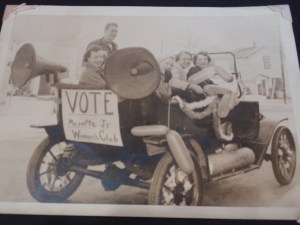
- During the 1953 elections the Junior Club’s “Get out the Vote” campaign contributed to the largest voter turnout in the city in any prior election.
- In the 1960’s GFWC clubs including Marietta supported a nationwide campaign for street lighting to prevent crime and accidents.
- In 1947 the Marietta Woman’s Club sponsored the formation of the Marietta Junior Woman’s Club. In 1956 the Marietta Junior Woman’s Club gave a station wagon to Tallulah Falls School.
From its beginnings the Club has received recogniation for its projects, including support for the Georgia School for the Deaf, organ donation, children in forster care, women’s shelters, military families, Cobb County Juvenile Home, mental illness, elder abuse, voter registration and more.
The Club House on Polk Street
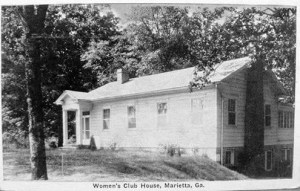
From the club’s first meeting, plans were made and discussed for a club house. In the fall of 1924 these plans, aided by Len Baldwin and Spark’s Circus, began to reach fruition and in 1925 former Georgia Governor Joseph E. (Joe) Brown donated the grounds on Polk Street for a club-house. In 1926 ground was broken and the clubhouse was formally dedicated on Thursday, March 17, 1927.
It was located on the corner of Polk and Walthall Streets which today is the site of Marietta Middle School Building 400.
The final report on the cost of the Club House was $4,969, with $1,700 borrowed. Money was raised by sponsoring the Sparks Circus for three years, starting in 1924. Club women sold tickets and refreshments. They also held bake sales and “At Home Days” where members could come and play bridge, sew or just visit at a cost of 25ȼ per person. Each club section (committee) pledged to raise $100. Each member pledged $10. Clubwomen, also served lunch for the public on certain days, hosted wedding receptions, showers and luncheons to raise money.
From an old book, published 1924, “The Big Tent, The Traveling Circus in Georgia, 1920 – 1930” we found the following quote:
“Marietta organizations had further opportunities to demonstrate their affection for Sparks Circus on a Sunday before the show’s scheduled Monday performance. The Sparks Band spent its day off performing a public concert in the city park and afterward enjoyed a possum and chicken dinner courtesy of the Shriners. As a parting gift, the Ladies Club of Marietta delivered fifty cakes to the Sparks steward for the enjoyment of the show’s employees.”
There were original plans to add tennis courts and a swimming pool, however they were not carried out. Instead the club secured a creek side cabin known as White Circle, which was sold to J. C. White after WWII.
The basement of the club was used by the high school as a cafeteria for many years and community events like scout meetings, school dances, and fashions shows were held there. The house served the Marietta Woman’s Club and the community for 50 years until 1977 when it was sold to the Marietta School District to build the then Marietta High School gymnasium.
 Welcome to GFWC Marietta Woman's Club